
Key Takeaways
UTVs have a higher center of gravity and more suspension travel than cars, which produces body lean in turns that feels alarming but is completely normal. The instinct to correct it by jerking the wheel is what actually causes tip-overs.
Weight transfer under acceleration and braking is far more dramatic in a UTV than in a car, and understanding it is the foundation of safe hill driving.
Shifting into low gear before a hill, not during the climb or descent, gives drivers the traction and control they need from the first foot of elevation change.
Most UTV rollovers trace back to excessive speed or overconfidence. The car-like controls create a false sense of familiarity that pushes new drivers into terrain they aren't ready for.
Steering into a skid on a 4WD UTV requires different technique than in a car. Snapping off the throttle can lock the rear tires; easing off smoothly while steering into the slide is the correct response.
At WildSide in Pigeon Forge, guided UTV tours cover every condition in this guide on 900 acres of private Smoky Mountain terrain, with Can-Am Maverick X3, Commander Max, and 6-seat Defender vehicles in 2- and 4-seat configurations.
Side-by-sides are among the most beginner-friendly off-road vehicles on the market. With familiar car-like controls, seatbelts, and side-by-side seating, they lower the barrier to entry for anyone curious about trail riding. But “beginner-friendly” isn’t the same as “no learning curve.” The same traits that make UTVs so capable off-road make them respond very differently than anything you’ve driven on pavement. A little preparation goes a long way.
Here’s what you actually need to know before your first ride.
Is Driving a UTV the Same as Driving a Car?
Not quite, and the differences matter most in the moments you least expect them.
UTVs share the basic controls: steering wheel, gas, brake, a gear selector. But a UTV has a significantly higher center of gravity, a narrower wheelbase relative to its height, and long-travel suspension engineered to absorb rough terrain rather than resist it. On pavement, those traits would be liabilities. Off-road, they’re exactly what you want.
The thing new drivers aren’t prepared for is body lean. In a car, meaningful body roll is a warning sign that the vehicle is close to its handling limit. In a UTV, noticeable lean in a turn is the suspension doing exactly what it was designed to do. The vehicle is nowhere near tipping. But because it feels like a car at its limit, the instinct is to jerk the wheel or brake hard. Both responses make the situation worse. A UTV that’s leaning through a turn and being driven smoothly is fine. The same UTV with a panicked overcorrection mid-corner is not.
The second thing that surprises new drivers is weight transfer. UTVs shift their weight dramatically under acceleration and braking, much more than a passenger car does. Brake hard going downhill and the weight slams to the front; the rear gets light and loses grip. Accelerate hard from a stop on an incline and the front lifts. Understanding weight transfer is the mental model that ties together almost every driving tip on this list, especially anything related to hills.
Learn how your machine moves before you push it.
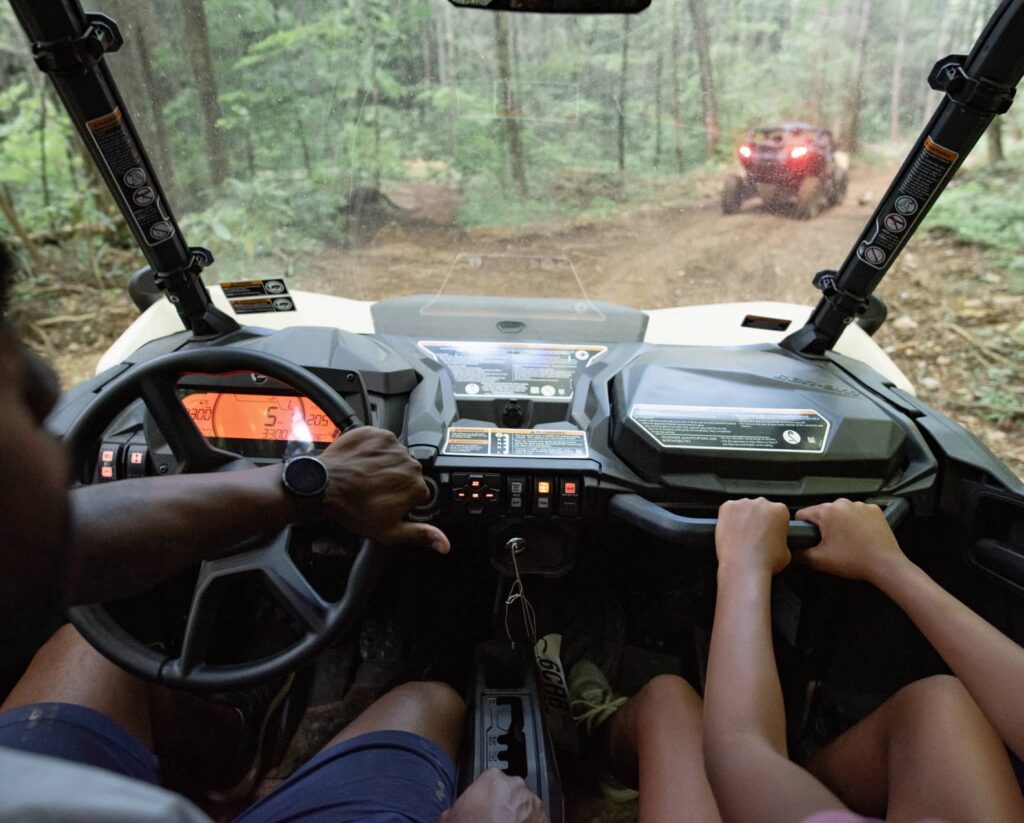
What to Do Before You Drive a UTV Off-Road for the First Time
A few important steps before you hit the ignition.
Gear up correctly. Wear a full-face helmet, goggles, gloves, long pants, a long-sleeved shirt, and over-the-ankle boots. Buckle your seatbelt before you move an inch. Off-road terrain throws the vehicle unexpectedly, even at low speeds. The roll cage is designed to protect you, but only if you’re fully inside it and buckled in.
Read the owner’s manual for your specific vehicle. This matters more than most new riders expect. Transmission type, gear positions, parking brake location, 4WD engagement method, differential lock, and weight limits all vary by model. The Can-Am Maverick X3, Commander Max, and 6-seat Defender (the vehicles used on WildSide’s guided tours) each handle differently. Take 10 minutes to review your manual before your first ride.
Do a proper pre-ride inspection. A few minutes of inspection can prevent a breakdown, a belt failure, or something worse, out on the trail. Here’s what to actually check:
- Tires: Consult your owner’s manual for model-specific PSI. Most Can-Am side-by-sides run 12 to 18 PSI depending on terrain. Underinflated tires on rocky terrain increase sidewall damage risk; overinflated tires reduce grip in mud and loose soil.
- Brakes: Press the brake pedal before moving. If it feels soft or spongy, don’t drive until the system has been inspected. A spongy pedal almost always means air in the brake lines.
- CVT Belt: This is the check most beginner guides skip, and it’s the most important one. The CVT belt is the single most common failure point on side-by-sides. Visually inspect it for cracks, glazing, fraying, or missing chunks. A cracked belt caught in the parking lot is a minor inconvenience. The same belt breaking mid-trail is a completely different situation.
- Fluids and lights: Check oil level and coolant. Confirm headlights, brake lights, and any 4WD indicator lights are working correctly.
- Steering: Before moving, turn the wheel lock to lock. It should move freely with no binding, grinding, or excessive play.
13 Beginner Tips for Driving a UTV Off-Road for the First Time
The 13 tips below are drawn from the most common mistakes WildSide’s guides see on the trail, combined with the mechanical realities of how a side-by-side actually behaves off-road. Some are counterintuitive. Most are things no one tells you until after something goes wrong.
1. Let Your Eyes Lead, Not Your Throttle
On unfamiliar terrain, resist the urge to match the pace of riders around you. Scan ahead so you have time to read obstacles, ruts, and grade changes before you reach them. The critical distance is longer than you think. At 20 mph you cover nearly 30 feet per second. Speed is easy to add once you’ve learned the terrain. Managing it after the fact is a different story.
2. Stay on Designated Trails
Paved roads are genuinely dangerous for UTVs. The deep, aggressive tread built for dirt, rock, and loose terrain behaves erratically on asphalt. Handling degrades fast and rollover risk increases significantly. Stick to designated off-road trails where the vehicle is designed to perform.
3. Keep All Limbs Inside the Cab
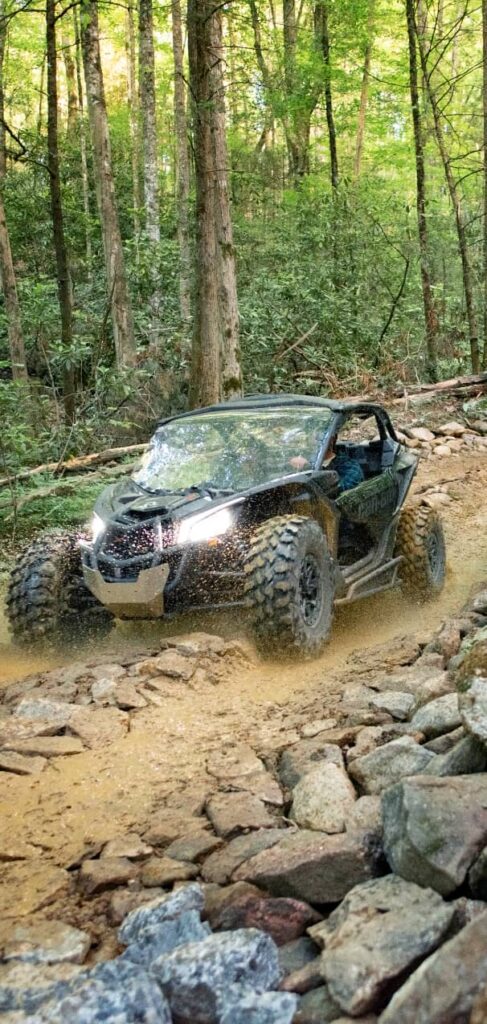
This matters more than it sounds. At even moderate trail speeds, trail debris doesn’t need to be moving to cause injury. Your vehicle’s own momentum does the damage. At 15 mph, an outstretched arm catching a branch absorbs roughly the same force as a collision. The roll cage exists to protect occupants who are fully inside it. It provides no protection for limbs outside the cab.
4. Never Crest a Hill Blind
A sharp drop, a stopped vehicle, or a trail obstacle could be just on the other side of any ridgeline. Slow down as you approach the top and treat every crest as unknown terrain until you can see what’s ahead. This is especially relevant on mountain terrain like WildSide’s trails, where elevation changes are sharp and sightlines cut off quickly. Cresting a hill at speed is one of the most consistent causes of UTV accidents on wooded mountain trails.
5. Keep Your Thumbs Outside the Steering Wheel
On rocky or rooted terrain, the front tires can strike an obstacle and send a violent kickback through the steering wheel in a fraction of a second. If your thumbs are hooked inside the rim, that force will break them. Keep your hands at the 9-and-3 position with thumbs resting outside the wheel. It’s a small habit that prevents a surprisingly common injury.
6. Don't Try to Brace a Rollover
If your UTV begins to roll, every instinct will tell you to throw out your arms or legs to stop it. Resist that instinct completely. A UTV weighs well over 1,000 pounds and you won’t slow it down. The attempt will likely cost you a limb. Stay buckled, hold the manufacturer-specified grab bars, and let the roll cage do its job. This is also why the seatbelt matters so much: an unbelted driver who tries to jump clear of a rolling UTV is far more likely to be crushed by it.
7. Ride to Your Skill Level
Overconfidence is one of the leading causes of UTV accidents. The car-like controls give new drivers a false sense of security — the machine feels intuitive right up until the moment it doesn’t. At WildSide, guides consistently see the same pattern: first-time drivers who feel comfortable within the first five minutes and start pushing pace before they’ve learned how the machine behaves on an incline or in loose terrain. Match your speed and line choices to your actual experience. The guided format exists specifically so someone with trail knowledge is setting the pace, not your confidence level.
8. Engage 4WD Before Climbing or Descending
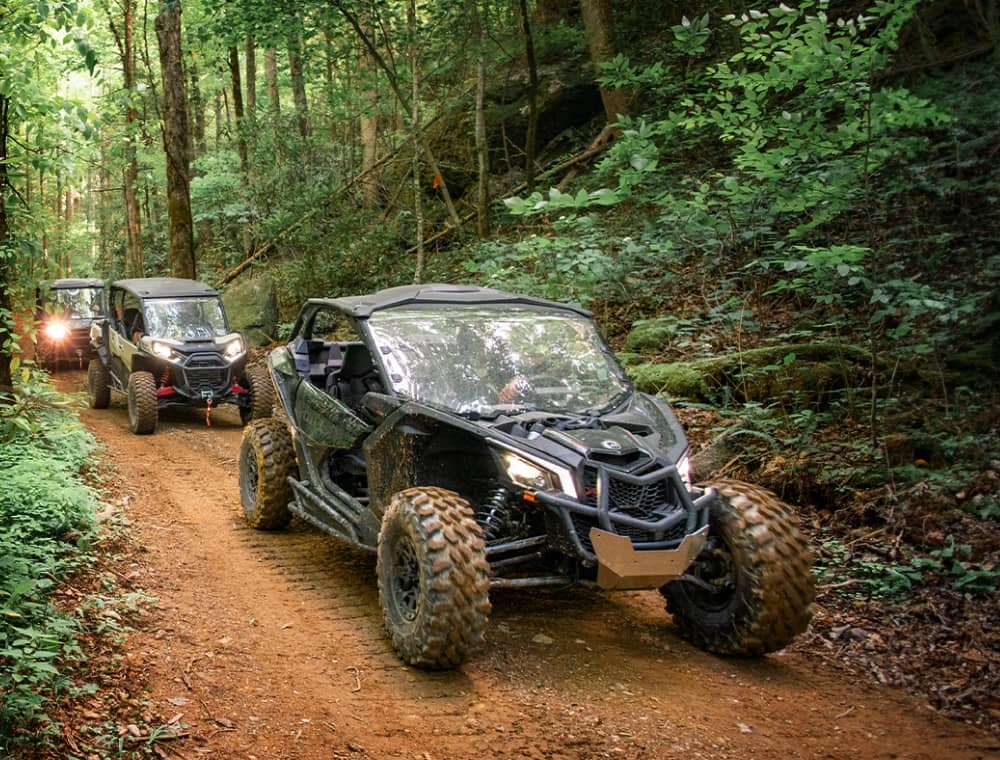
Switch into four-wheel drive before you reach the hill, not while you’re already on it. Engaging 4WD while wheels are under load and already spinning can damage the front differential on some models. On vehicles with manual locking hubs, you may not be able to engage them at all once you’re moving. The same rule applies to low range: engage on flat ground, while still rolling slowly, before you need it. Low range gives you the torque and engine braking you need from the first foot of the climb. Engaging it halfway up is too late.
9. Commit to Your Line in Mud and Sand
In loose terrain, existing ruts and grooves act like rails. Fighting the line usually makes things worse. If the existing path is safe, follow it. When you need to exit a rut, look ahead for your escape point, commit to it cleanly, and don’t second-guess mid-maneuver. Hesitation in soft terrain creates its own problems. A moment of indecision at low speed can leave you high-centered or spinning out.
10. Check Water Depth Before a Crossing
Stop and check the depth on foot before driving through any standing or moving water. Depth is nearly impossible to judge accurately from the seat, and water reaching your electrical components or air intake can cause serious damage. WildSide’s trails include real creek crossings through Smoky Mountain streams — not simulated obstacles — and the depth changes with rainfall. Cross slowly and steadily. The instinct to gun it through to “power through” is one of the most consistently damaging mistakes new UTV drivers make. The bow wave the vehicle creates can push water directly into the air intake.
11. Body Roll in Turns Is Normal — Don't Fight It
UTVs roll more in corners than cars do, and that sensation catches new drivers completely off guard. The two most common reactions are jerking the wheel or slamming the brakes, and both make the situation worse. Over-correcting causes unpredictable lateral sway; hard braking mid-corner can cause the rear tires to catch on rocks or debris and snap the vehicle sideways. The correct response is counterintuitive: stay smooth, ease through the turn, and trust that the suspension is doing its job.
12. Steer Into a Skid. Never Brake.
The principle is the same as in a car: steer in the direction the rear is sliding. But the technique is different on a 4WD UTV. In a car, you lift off the throttle sharply and counter-steer. In a UTV, snapping the throttle closed can lock the rear tires almost instantly because of how 4WD distributes power under deceleration. The correct sequence: ease off the throttle smoothly, not abruptly, while simultaneously steering into the slide. A vehicle that starts to slide downhill or tip sideways needs to be turned downhill and brought to a controlled stop. Braking mid-skid, before the vehicle is pointed in a safe direction, almost always makes the situation worse.
13. Feather the Throttle When Braking Downhill
On UTVs with a CVT (continuously variable transmission), maintaining light throttle pressure while braking on descents keeps the belt engaged and reduces drivetrain wear. Letting the CVT fully disengage and re-engage repeatedly on steep terrain stresses the system. Use light, consistent throttle rather than going fully off-gas on the way down.
FAQs
How to Drive a UTV Uphill?
Shift into low range before you reach the base of the hill, lean your weight forward over the front wheels, and apply smooth, steady throttle throughout the climb. Don’t modulate the throttle aggressively. Momentum is your friend on a climb, and a sudden power surge mid-hill can cause the front end to lift.
Approach every climb straight-on, never at an angle. An angled approach puts one side of the vehicle higher than the other, which raises the effective center of gravity and dramatically increases rollover risk.
If you lose forward momentum before the top, stop immediately and set the parking brake. Do not attempt to reverse down. Reversing off a hill is one of the most dangerous maneuvers in UTV driving. A UTV’s brakes are significantly weaker in reverse, and the weight distribution shifts downhill toward the front wheels, which are now the wheels with the least grip. Backward rollovers are among the most severe UTV accidents. If a safe U-turn isn’t possible, dismount on the uphill side of the vehicle and call for assistance.
How to Drive a UTV Downhill?
Shift into low range before you start the descent, move your weight rearward, and use gradual, even braking. Let engine compression do most of the work slowing you down. That’s what low range is for.
Before you begin descending, choose the straightest, most obstacle-free line available. Avoid abrupt front braking. Hard front braking shifts weight dramatically to the front wheels, lightens the rear, and can pitch the nose forward into a rollover. Never back a UTV down a steep hill nose-first. The same weight transfer dynamics that make forward descent manageable make reverse descent unpredictable and dangerous.
How to Avoid UTV Rollover?
Stay buckled, manage your speed for the terrain, keep cargo low and evenly distributed, and avoid aggressive acceleration from a stopped position. Front wheel liftoff (the front rising under hard acceleration) is a leading cause of backward rollovers.
The highest-risk maneuver for rollover is sidehilling: traversing a steep slope at an angle rather than straight up or straight down. Sidehilling combines a high center of gravity with lateral weight transfer in the worst possible way. Minimize it whenever the trail allows. When it’s unavoidable, reduce speed significantly and avoid any sudden steering inputs.
Most UTV rollovers trace back to excessive speed or driver error, which means they’re preventable. Keep cargo low and centered. A high or unbalanced load raises the center of gravity and destabilizes the vehicle in ways that aren’t obvious until a turn or a bump reveals it.
When Should You Use Your UTV’s Low Gear?
Use low range on steep climbs and descents, in mud, sand, or rocky terrain, when towing or carrying a heavy load, or any time you need maximum torque and precise control over speed. Low range multiplies engine torque to the wheels, which is what lets you push through difficult terrain without overworking the drivetrain.
The rule is simple: when the trail gets technical, drop into low. Engage it before you need it, not after you’re already in trouble. On trails like the ones at WildSide, with mountain slopes, creek crossings, and the elevation change up to Raven’s Den, most drivers will use low range more than they expect to.
Explore the Smokies With a UTV at WildSide
Understanding UTV driving on paper and feeling it in a real machine on real terrain are two different things. WildSide’s guided UTV tours are designed to give you both in the same 90 minutes.
Behind the wheel of a Can-Am Maverick X3, Commander Max, or 6-seat Defender, you’ll navigate mountain slopes, creek crossings, forest paths, and panoramic lookouts on private trails across 900 acres of Smoky Mountain terrain. Every tour is fully guided, so the pace is calibrated to your group and you’re never figuring out unfamiliar terrain on your own. The route includes a scenic lookout point roughly halfway through, a good natural stopping point before the descent back to Basecamp.
Every condition covered in this guide shows up on WildSide’s trails: body roll in tight turns, hill ascents and descents, water crossings, loose-surface skids. There’s no better place to learn how your machine actually behaves than with a guide who’s seen every beginner mistake in the book and knows how to correct it before it becomes a problem.
Learn more about our UTV tours today. If you’re ready to go on an off-roading adventure, book your ride online.