
Key Takeaways
This guide targets new riders who’ve already started mountain biking and want more control, smoother flow, and fewer sketchy moments before moving up to harder trails.
A basic safety setup (including a properly fitting helmet, gloves, eye protection, water, and a flat plan) keeps rides safer and practice more productive.
Centered body position with soft elbows and knees improves balance, braking control, and stability on descents.
Looking ahead at your intended line reduces target fixation on roots, rocks, and loose patches that can pull your front wheel off course.
Braking early in a straight line, cornering with eyes on the exit, staying loose over rough terrain, and choosing safer lines on beginner-friendly trails lowers crash risk while you improve.
If you’ve started mountain biking recently and have started to get the basics, you’ll likely still be experiencing moments where you feel a little out of your depth. While most beginner’s mountain biking guides focus on what you should know for your first ride, this one is designed for those who have gone on a few rides and want to master the basics before they try a harder trail.
If you want more control, better flow, and fewer sketchy moments while you ride, take a moment to review our top MTB tips for beginners.
Quick Safety Baseline Before You Push Your Skills
You don’t need a gear shopping spree, but a few basics make every ride safer and more productive. Some general safety practices to follow before your next ride:
Check helmet fit
A snug, level helmet that doesn’t rock side to side protects you when mistakes happen.
Wear gloves and eye protection
Gloves help with grip and fatigue, and glasses protect your eyes from dust and branches.
Bring water and have a flat plan
Bring water, a snack, and what you need to fix a simple flat, or ride with someone who has those basics covered.
7 MTB Tips for Beginners
Whether you’re looking for help with braking smoothly or want some basic mountain bike cornering tips, you can benefit from reviewing the following seven mountain biking tips for beginners:
1. Build a Strong Athletic Stance
A stable stance gives you more control when the trail changes quickly. With your weight centered and your arms and legs ready to absorb impacts, you can brake smoothly, steer around surprises, and stay balanced on descents.
Proper mountain bike body positioning starts with keeping a soft bend in your knees and elbows and centering your hips over the bike. Next, put light pressure through your hands and stronger pressure through your feet. For descending tips that mountain biking beginners can apply right away, stay balanced, keep your chest open, and shift your weight back slightly as the trail steepens while keeping your eyes up.
2. Look Where You Want to Go
Your bike follows your eyes more than you think. Newer riders often stare at the problem (such as root clusters, rocks, and loose patches), causing the front wheel to drift toward it.
Scan ahead for your line rather than fixating on the next obstacle. Keep your chin up and your eyes moving, especially before corners and rough patches. When something looks sketchy, pick a safer target, like the clean dirt between roots, and aim for that spot.
3. Brake Early, Use Both Brakes, and Stay Balanced
If you want to know how to brake on a mountain bike, start by slowing down in a straight line before the corner or rough section, since braking mid-turn usually reduces traction when you need it most. Use both brakes with a progressive squeeze instead of a sudden grab.
The front brake provides most of your stopping power, and the rear brake adds stability and helps you trim speed without upsetting the bike. While you’ll primarily rely on your front brake, use the rear brake to steady the bike and trim speed, especially on loose surfaces or steeper descents where you may briefly release the front brake to keep momentum. If the rear wheel starts to skid, ease off and reapply pressure with lighter pressure, as modulation helps you maintain traction and control.
4. Shift With Intention
Shifting gets messy when you wait until the climb is already crushing you. Shift before the trail steepens and while you can still pedal smoothly. Next, ease pedal pressure slightly during the shift so the chain moves cleanly.
5. Know How to Corner on a Mountain Bike
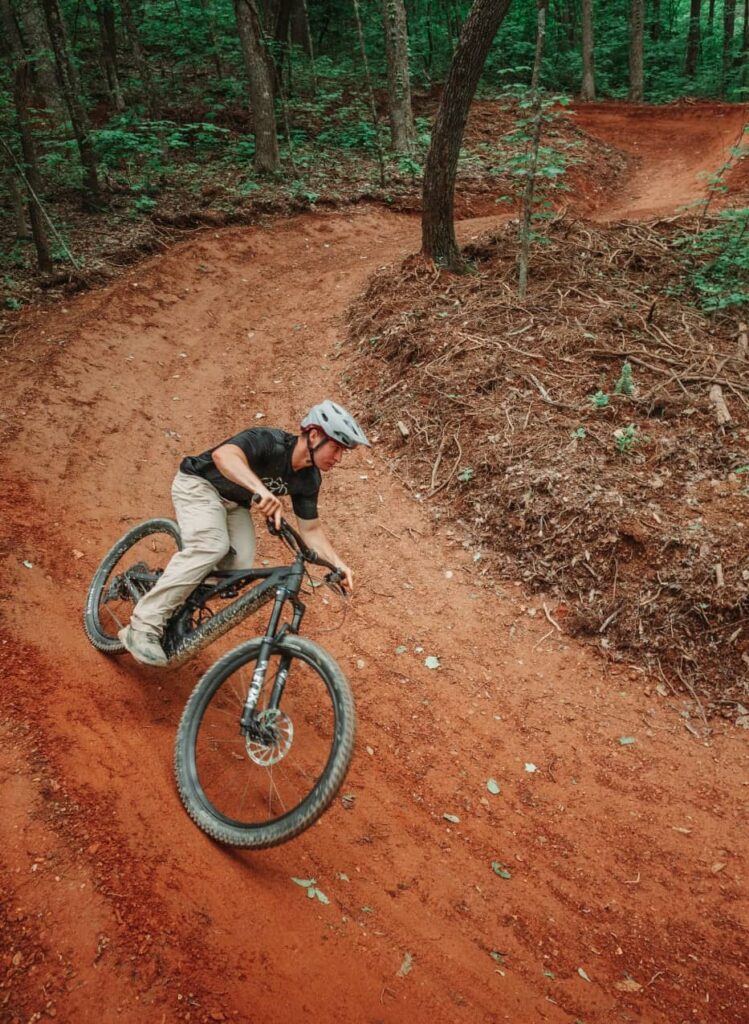
Corners are where confidence often fades, especially when speed carries you wide. To stay in control, slow down before the corner while the bike is upright. Look through the turn toward your exit, leaning the bike beneath you while your body stays stable and balanced.
6. Stay Loose Over Roots and Rocks
Stiff arms and a death grip turn small bumps into big problems. A relaxed body allows the bike to move beneath you.
Keep elbows and knees soft and allow them to absorb impact. Hold the bars firmly enough to steer while keeping your grip relaxed. When the trail gets choppy, press your weight into the pedals and keep a relaxed grip on the bars.
7. Choose Safer Lines
If you want to know how not to crash in mountain biking, one of the best things you can do is stick to MTB trails that are appropriate for beginners. Doing so will ensure you’re not overwhelmed and can practice other key skills, such as braking, cornering, or passing over rocks, without being overly challenged.
To find a safe, beginner-friendly line, scan for smooth dirt, stable rocks, and predictable traction. Avoid the middle of a root cluster when a clean edge line exists, and give yourself permission to take the easier option, especially on a new trail. If the trails are color-coded according to the IMBA Trail Difficulty Rating System, stick to trails with a White Circle (easiest) or Green Circle (easy) since they’re the most appropriate for beginners.
A Simple Progression Plan for Your Next 3 Rides
You’ll improve faster when each ride has a clear goal.
- Ride 1: Focus on braking early and looking ahead. Repeat one corner three times.
- Ride 2: Work on athletic stance and staying loose over rough sections. Choose one short rocky stretch and ride it twice.
- Ride 3: Combine your corner routine and line choice. Pick a trail you know and ride it with smoother exits as the priority.
Train Your Mountain Biking Skills at WildSide
If you’re looking for beginner-friendly mountain biking trails in Pigeon Forge, WildSide has you covered. At our adventure park, we have 20 mountain bike trails covering 11+ miles and a variety of difficulty levels, ranging from beginner to professional only. When you don’t have your own bike, you can also rent a standard or electric mountain bike at our park, and we offer multiple classes to help new riders improve their skills.
Learn more about our mountain biking trails and rentals today. If you’re interested in taking a fundamentals class or improving your skills, you’ll also want to review our class offerings.